Engineers successfully position giant 12-tonne component for fusion upgrade
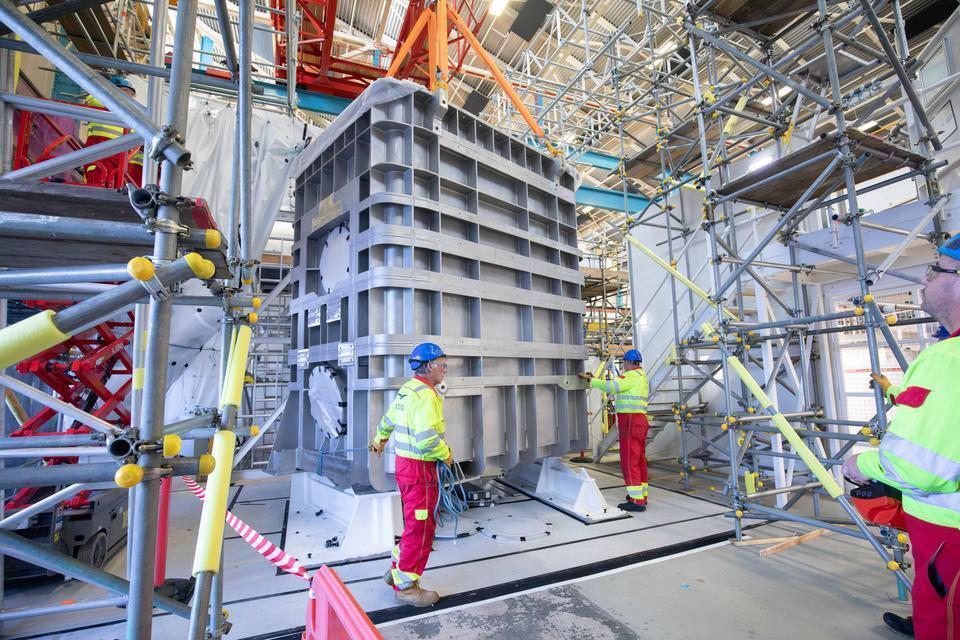
Engineers at the UK Atomic Energy Authority (UKAEA) have successfully positioned a significant 12-tonne component for the MAST Upgrade, the UK’s leading fusion machine, located at UKAEA’s Culham Campus.
New component enhances fusion research capabilities
The newly installed double beam box, designed with a double-decker configuration, will accommodate two neutral beam injectors (NBIs). These injectors are crucial for fusion research, as they propel high-energy neutral atoms into the plasma, elevating its temperature beyond 30 million degrees Celsius.
With the addition of these two injectors, the heating power of MAST Upgrade will increase from 4.4 megawatts (MW) to 8.8 MW. This enhancement is anticipated to raise plasma temperatures to 60 million degrees Celsius, allowing researchers to examine the technologies and physics necessary for future fusion power plants, including the UK’s prototype fusion power plant, STEP.
Significance of the upgrade
Andrew Thornton, Head of MAST Upgrade Operations at UKAEA, highlighted the importance of the double beam box installation. He noted that the increased heating power would enable exploration of plasma conditions previously unattainable, facilitating studies on higher-pressure plasmas and the performance of the MAST Upgrade exhaust system with these elevated conditions.
Such investigations are vital for the development of STEP and other future fusion power facilities, exemplifying the engineering expertise and teamwork within UKAEA’s science and engineering divisions.
Ongoing engineering enhancements
The installation of the double beam box is part of a broader engineering initiative for MAST Upgrade, which includes the implementation of a new electron Bernstein wave (EBW) microwave heating system. Additional upgrades involve:
- Repurposing power supply equipment from the Joint European Torus (JET)
- Fabricating and installing the beam line module for neutral beam injection into the plasma
- Manufacturing and assembling a cryopump to manage pressure within the double beam box
- Installing positive ion neutral injectors (PINIs)
Specifications of the double beam box
The completed double beam box vessel, including its lid, is expected to weigh approximately 15 tonnes, about the same as two and a half African elephants. It has a volume of 20 cubic metres, equivalent to around 130 bathtubs, and is constructed from 316L stainless steel, known for its strength, durability, and corrosion resistance. This material is suitable for the ultra-high vacuum conditions essential for the vessel’s operation.
All major components are projected to be manufactured and installed within the double beam box vessel by the end of autumn 2027, with commissioning for scientific experiments planned to commence in 2028.
Source: Department for Energy Security and Net Zero