Christopher Turner receives honorary Doctor of Science from Anglia Ruskin University
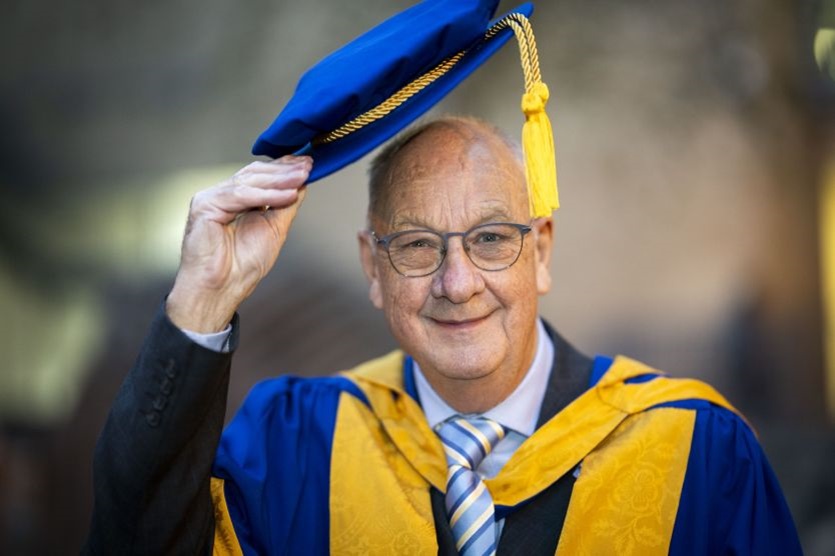
Pioneering engineer Christopher Turner has received an Honorary Doctor of Science from Anglia Ruskin University (ARU) during a graduation ceremony in Cambridge, recognising his significant contributions to the home computing revolution.
Career highlights and contributions
Throughout a career spanning over five decades, Turner played a vital role in the development of the BBC Micro, a key innovation in British technology. His journey began in Cambridgeshire, where, at the age of 10, he started repurposing components from radios and building audio devices from kits. In 1967, he began his professional career at the University of Cambridge’s Cavendish Laboratory.
Initially employed as a technician in the crystallography department, Turner quickly advanced to building logic boards for a PDP-11 computer and later moved to the main electronics workshop. It was there that he met Hermann Hauser, an Austrian PhD candidate who would become instrumental in Turner’s career.
From Acorn Computers to Arm
In 1978, after completing his engineering qualifications, Turner was recruited by Hauser to develop a computer for Sir Clive Sinclair’s Science of Cambridge. This led to Turner working on the MK-14 microprocessor kit. Soon after, Hauser co-founded CPU Ltd, where Turner became the first employee and Chief Engineer, eventually transitioning to Acorn Computers. Under their leadership, Acorn became a key player in the ‘Cambridge Phenomenon’, developing the Acorn Atom microcomputer and the widely celebrated BBC Micro.
After Acorn was acquired by Olivetti in the mid-1980s, Turner took on the role of Operations Manager at Olivetti Research Laboratory. His work there contributed to the development of Asynchronous Transfer Mode switches and the spin-out of Virata Corporation in 1993, where he served as Vice-President of Operations and IT for seven years.
In 2010, he joined Arm, the microprocessor company that evolved from Acorn, where he played a crucial role in defining safety-critical processors used in autonomous vehicles and aerospace systems.
Acknowledgements and advice
During the ceremony, Turner expressed his gratitude for the award, crediting the supportive faculty at the Cambridge College of Arts and Technology. He reflected on his career, noting the satisfaction of working on projects that may remain unseen by the public but are nonetheless impactful. He encouraged the 237 graduates to find fulfilment in their future careers.
Professor Marcian Cirstea, Head of the School of Computing and Information Science at ARU, praised Turner as a role model, highlighting his embodiment of the connection between ARU’s engineering education and global innovation.
Source: Anglia Ruskin University